
The winding road up to Yamdrok Lake was a journey of contrasts. As the vehicle crept higher into the mountains, the landscape shifted from the dry, dusty plains of Lhasa to something more alive, more vibrant. The sun was beginning its slow descent, casting the entire world in a golden glow, and as we reached a particularly steep bend, I saw it.
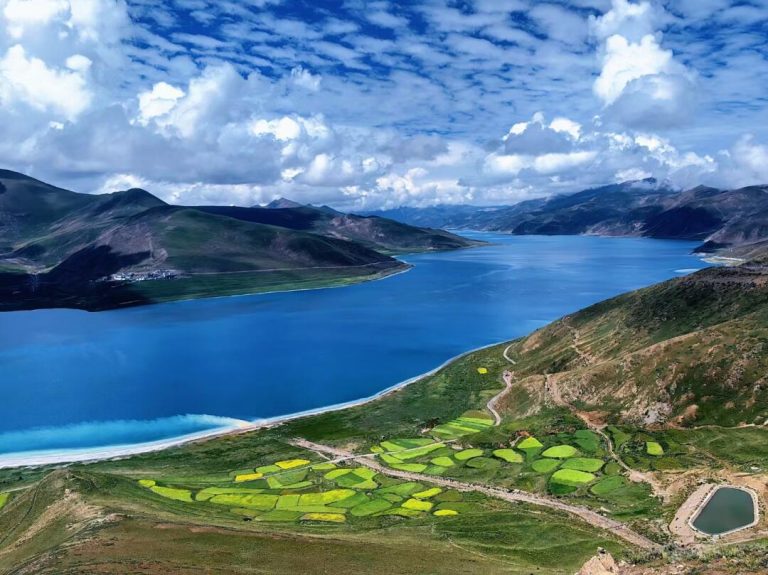
Yamdrok Lake—its vast surface stretched out before us, a shimmering turquoise expanse that seemed to pulse with life. It was as though someone had taken the sky itself and dipped it into the earth. Tsering, who had been quietly observing my reaction, spoke at last.
“This is one of the most sacred lakes in Tibet,” he said, his voice rich with reverence. “It’s believed to be the transformed body of a goddess, and its waters are said to have healing properties. Some say that the lake’s color changes with the seasons, that it’s a reflection of the goddess’s moods.”
I could hardly take my eyes off the lake. From our vantage point, the water appeared to stretch endlessly, merging with the sky at the horizon in a seamless blend of blue and turquoise. The surrounding mountains stood like silent sentinels, their jagged peaks dusted with the last traces of winter’s snow. It was a scene so perfect, so untouched, that it felt almost unreal—a place where nature’s beauty seemed to exist outside of time.
Tsering’s words echoed in my mind as we began our descent toward the lake’s edge. The further we drove, the more surreal the landscape became. The road twisted and turned, hugging the contours of the mountainside, and as we got closer to the water, I felt a shift within myself, as though the beauty of the place was pulling something out of me—a quiet, meditative calm that I hadn’t known I needed.
At the lake’s shore, the air was cooler, tinged with the faint scent of the grass that grew wild in the area. We stepped out of the car, and I could feel the change in the atmosphere. There was a palpable stillness here, a peace that seemed to settle over everything. The lake’s surface was like glass, reflecting the mountains and sky in perfect symmetry. I couldn’t resist—walking to the water’s edge, I knelt down and dipped my fingers into the cold, clear water.
The sensation was startling. It wasn’t just the cold—it was the purity of the water, as though it held an energy all its own. Tsering stood beside me, watching me with an unreadable expression. “The goddess is said to speak to those who truly listen,” he said softly. “Her voice is in the wind, in the ripples of the water. It’s a gift, if you can hear it.”
I didn’t know what he meant at first, but as I sat there, watching the light play off the lake’s surface, something did shift within me. Perhaps it was the serenity of the place, or the sheer beauty of the surrounding landscape, but I found myself in a deep moment of reflection. My mind, often so filled with noise and distraction, was suddenly quiet. The world seemed to slow down, each moment stretching out in perfect clarity.
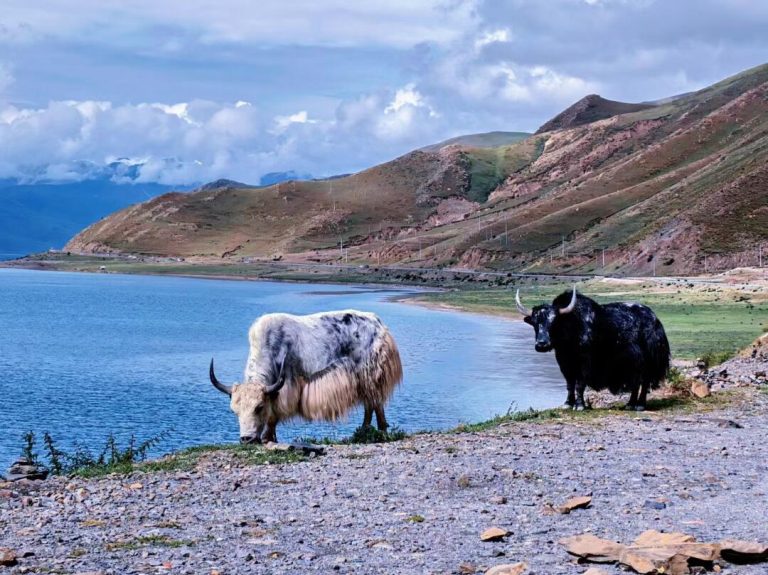
Tsering guided me along the shore, pointing out small shrines tucked into the rocks, each one adorned with colorful prayer flags. “Pilgrims come here to pray for health, for peace, for prosperity,” he explained. “It is a place of connection—a place where the spiritual world and the physical world come together.”
We walked for a while in silence, the only sounds being the rustle of the prayer flags in the breeze and the distant call of birds soaring high above the lake. I couldn’t help but feel as if the lake had become a mirror for my own soul, reflecting back at me the parts of myself I often overlook—the quiet longing, the deep desire for peace, the hope for healing.
As we made our way back to the car, the sun had almost set, and the sky above the lake had taken on the most breathtaking shades of orange and purple. The mountains in the distance, once sharp and imposing, now seemed softer, as if the fading light had softened their edges, giving the entire scene an ethereal quality. The lake, too, had deepened in color, turning a darker shade of blue, its surface now rippling gently under the evening breeze.
Before we left, Tsering turned to me one last time. “You may not hear the goddess’s voice today,” he said with a knowing smile, “but you will take a piece of this place with you, always.”
As we drove away from Yamdrok Lake, the light of the setting sun fading behind us, I felt a sense of tranquility settle into my heart, a feeling that I had never quite experienced before. It wasn’t just the lake that had left an impression on me; it was the deep silence, the profound beauty of the landscape, and the feeling of connection that seemed to permeate the air.
The journey had taken me to the heart of Tibet’s natural wonders, but more importantly, it had taken me deeper within myself. Yamdrok Lake, with its surreal beauty and spiritual significance, had become not just a place I visited—but a part of me, a memory etched in my soul.