Tibetan mala beads are a category of objects used in Buddhist contemplative traditions — primarily for counting mantra recitations and providing a tactile anchor during seated practice. This guide covers the material properties of common mala bead types, the craftsmanship involved in their production, and practical guidance for selection and care.
What Is a Mala?
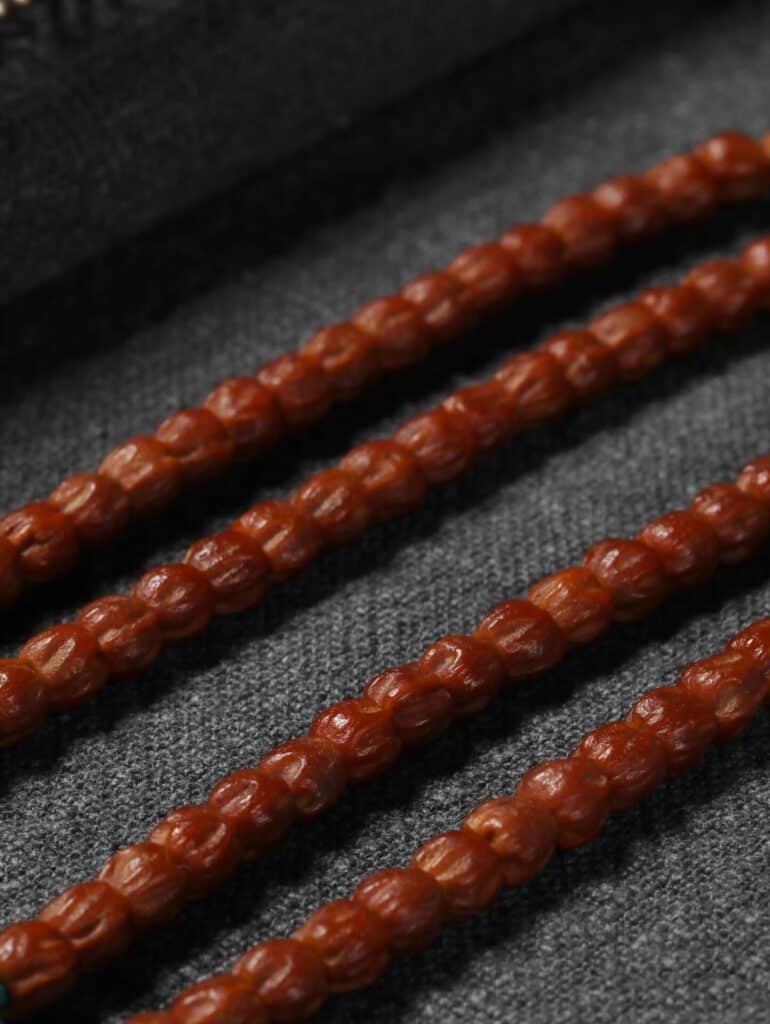
A mala is a string of beads used to count repetitions of a phrase, name, or sequence during practice. The most common format is 108 beads plus one larger guru bead, with a tassel attached. Some traditions use 27-bead or 54-bead formats as shorter alternatives.
The beads are moved through the fingers one at a time, with each bead representing one count. The guru bead marks the starting point and is not typically counted during rounds.
Common Bead Materials and Their Properties
Mala beads are made from a range of natural materials. The choice of material affects the tactile quality, durability, and appearance of the mala — not any measurable physiological or energetic effect.
Bodhi seeds (Magnolia champaca): Pale cream-colored seeds with a wrinkled surface. Moderely hard. The surface texture provides good tactile feedback when counting. Bodhi seeds are among the most traditional bead materials in Himalayan Buddhist contexts.
Rudraksha seeds (Elaeocarpus ganitrus): Blue-grey drupes with a knuckle-like surface texture. Available in “faces” (number of grooves) — more-faced beads are considered rarer and more expensive. Hard and durable. The surface is noticeably rougher than Bodhi seeds.
Sandalwood (Santalum album): Pale yellow to light brown, with a distinctive fragrance from natural sandalwood oil. Softer than stone or bone beads; can be damaged by impact. Fragrance fades over time with use and exposure to air. Authentic Indian sandalwood is a restricted commodity; many “sandalwood” beads are alternate wood species or heavily scented substitutes.
Yak bone: Smooth, creamy white beads with a slight translucency. Bone is denser and heavier than wood. As a natural material, each bead shows slight variation in color and surface character. Bone beads can be carved to very consistent sizes.
Semi-precious stones (agate, quartz, lapis lazuli, turquoise): Stone beads are the hardest and smoothest of the common mala materials. Their weight provides a distinct tactile quality. Color varies by stone type: agate has banded patterns in earth tones; rose quartz is pale pink; lapis lazuli is deep blue with flecks of pyrite; turquoise ranges from pale green to medium blue.
Material selection is primarily aesthetic and practical — the color, weight, and surface texture of a bead material are the most relevant properties for most practitioners.
Craftsmanship: How Malas Are Made
The production of a mala involves several steps:
Bead carving or sorting: Stone and bone beads are shaped by carving or grinding. Seed and wood beads are sorted for size and shape uniformity. Beads are drilled with a small hole for the cord — typically 1–2 mm diameter.
Quality sorting: Beads are sorted by consistency of size, shape, and color. Uniformity matters for the tactile experience during counting — inconsistent beads create an irregular feel when sliding through the fingers.
Stringing: Beads are strung on a strong cord, usually silk or a synthetic thread. The guru bead is placed at the position marking the starting point. A tassel is attached to the guru bead, traditionally made from silk or cotton.
Signs of good craftsmanship: consistent bead size and hole alignment, secure knots between bead sections, and a durable cord that does not Fray readily at the drill holes.
Frequently Asked Questions
What does the number 108 mean?
The number 108 appears in several Hindu and Buddhist numerical associations. In Buddhist contexts, it is most commonly noted as the number of defilements or aggregates discussed in some philosophical texts. The significance attributed to 108 beads in malas is part of the traditional form of the object rather than a medically verifiable claim.
Do certain materials have specific effects on focus or mood?
The tactile and visual qualities of a material may influence subjective experience during practice — this is a common observation. Any specific claim that a material “opens” a chakra, “removes negative energy,” or “brings wisdom” is a cultural or commercial narrative, not a claim supported by material science.
How do I care for my mala?
Keep the cord dry. Natural fiber cords (silk, cotton) degrade faster than synthetic cords in humid conditions. Wipe beads after each use. Store in a pouch when not in use. If the cord shows signs of fraying, have the mala restrung rather than continuing to use it.
What’s the difference between a ” Tibetan” mala and others?
The descriptive label “Tibetan mala” generally indicates the style, bead material categories, and cultural context of the Himalayan region — it does not certify that every component was manufactured within Tibet’s borders. As with most craft traditions, production chains are often multi-country.