
The first rays of dawn had barely begun to touch the rooftops of Lhasa when I found myself standing at the threshold of Jokhang Temple. Tsering had mentioned that mornings here were magical, but no words could have prepared me for the scene that unfolded before my eyes. The air was crisp, filled with the distant hum of chanting, and as the sunlight spilled over the ancient temple’s walls, I felt the weight of centuries pressing in around me.
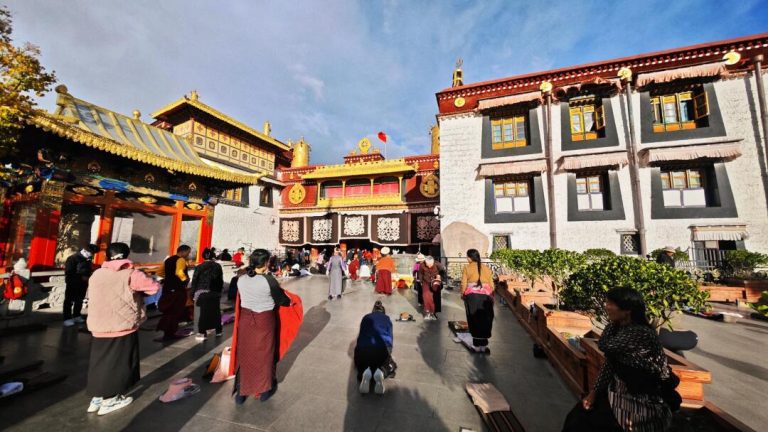
Jokhang Temple is the heart of Tibetan Buddhism, a sacred place where the devout come to pay homage to the revered Jowo Shakyamuni Buddha. It is said that the temple itself radiates a spiritual energy that has remained undisturbed for over 1,300 years. But today, it was not just the sacredness of the temple that struck me—it was the sheer intensity of the human presence that swirled around it.
As I crossed the threshold into the courtyard, I was enveloped by a sea of pilgrims, each one intent on their ritual. They moved in rhythmic waves, their prayer wheels turning in unison, their voices rising in a low, constant murmur. Some had traveled from distant corners of Tibet, others from Nepal and India, all drawn here by the pull of faith. There were old women with weathered faces, their eyes closed in deep concentration, their hands moving with practiced grace over their prayer beads. Young men walked with purposeful steps, their faces etched with a quiet determination.
Tsering led us through the crowd with ease, offering a few words of wisdom about the temple’s significance. “This is not just a place of worship,” he explained, his voice soft but steady amidst the bustle. “It is a place where the past and present converge, where every step taken by the pilgrims is an act of devotion, and where every prayer is a step toward enlightenment.” His words seemed to merge with the low chant of the crowd, blending into the very fabric of the temple’s energy.
Inside the temple, the atmosphere shifted entirely. The air was thick with the scent of burning juniper and butter lamps, the faint light of the early morning filtering through the wooden beams to cast dancing shadows on the walls. I found myself drawn to the heart of the temple, where the Jowo Shakyamuni statue sat, its serene expression radiating a calm that seemed to transcend time. The pilgrims gathered in reverence around the statue, some prostrating themselves on the cold stone floor, others whispering prayers with an intensity that bordered on desperation.
What struck me most was not the grandeur of the architecture, though the golden roof and intricate carvings were undeniably magnificent. No, it was the quiet, unwavering devotion of the people around me. The way they moved, the way their lips formed the words of ancient prayers, the way their hands trembled with the weight of their spiritual journey. There was a sense of surrender in the air, a complete immersion in the sacred, as if the very act of being here could lead them closer to enlightenment.
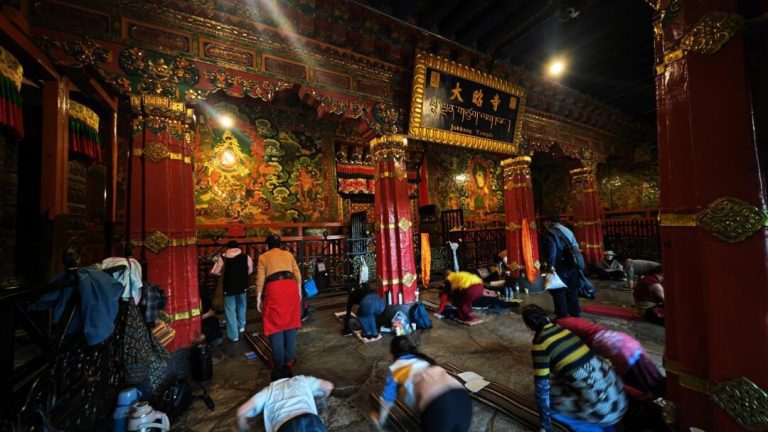
I wandered through the halls of the temple, my steps slow, careful not to disturb the sanctity of the space. In one corner, an elderly man sat cross-legged on the floor, his eyes closed, his hands pressed together in silent prayer. I couldn’t help but stop and watch him for a moment. He was completely at peace, his face illuminated by the soft glow of the butter lamps. There was no rush in his movements, no sense of urgency. In that moment, I realized that time itself seemed to slow down within these walls.
After a while, Tsering gently nudged me, and we made our way to the rooftop of the temple. From here, the view of the city below was breathtaking, the winding streets lined with pilgrims and traders, the golden roofs of the temple shining in the morning light. The Potala Palace, distant but imposing, loomed over the city, a silent guardian watching over the faithful.
We stood in silence, taking in the scene before us. Tsering smiled and said, “This is the essence of Tibet. The landscape, the people, the faith—it all comes together here in Lhasa.” His words hung in the air, almost as if they too were part of the sacredness of the place. I looked out at the endless sea of people below, their devotion palpable, and for the first time, I felt the weight of Lhasa’s spiritual power settle into my bones.
As the morning wore on, the crowds began to thin out, but the sense of reverence remained. The temple, though crowded, had a stillness about it, as though the very stones held centuries of prayers within them. I left Jokhang Temple that morning with a renewed sense of awe—not just for the temple itself, but for the incredible devotion of the people who had come to offer their prayers. It was a reminder that faith, in whatever form it takes, is something deeply personal, something that transcends the boundaries of language, culture, and time.