
It was a cold evening when we reached Namtso Lake, and yet, there was something about the place that made me feel a deep warmth, as if the very air was charged with an energy that radiated outward. Tsering had spoken of the lake with great reverence, describing it as one of Tibet’s most sacred spots, a place where the earth meets the sky in an eternal dance. I’d heard stories of the lake’s beauty, but nothing could have prepared me for the overwhelming presence of Namtso itself.
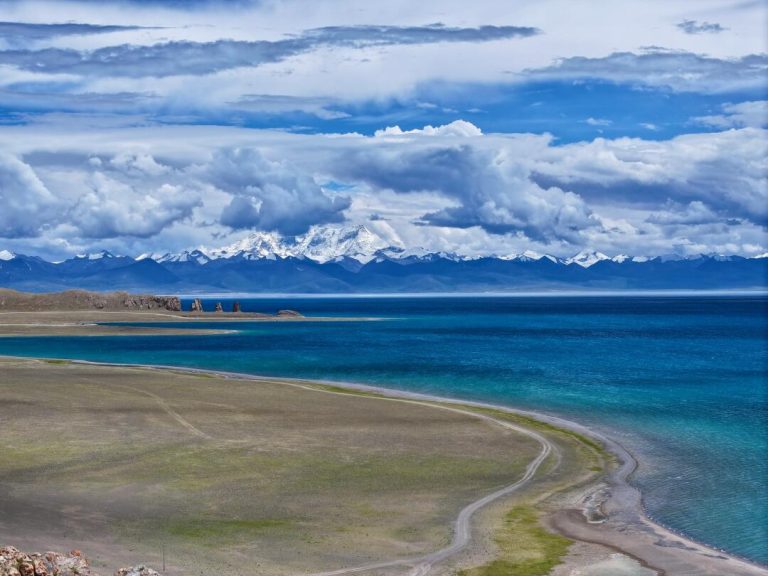
The sun had already dipped behind the snow-capped mountains as we made our way to the shores of the lake. The sky, though darkening, still held traces of twilight’s amber glow, casting a soft light across the landscape. The wind had begun to pick up, carrying with it the fresh, biting chill that seemed so characteristic of the Tibetan highlands. Yet, despite the chill in the air, I couldn’t tear my eyes away from the lake.
Namtso Lake lay before us like a vast, dark mirror, its surface so still it reflected the surrounding peaks in perfect symmetry. The mountains, their jagged edges softened by the evening light, stood like silent guardians around the lake, their snow-dusted peaks glowing in the last rays of the setting sun. The lake, too, seemed to glow, though it was a deeper, more mysterious hue—an intense shade of indigo that seemed to stretch into infinity.
Tsering had arranged for us to camp by the lake, a decision I was unsure about, considering the biting cold and the high altitude. But, as I sat beside him on a large stone, my breath visible in the frigid air, I realized how much I needed this. I needed the solitude, the silence, and the space to just… be.
As we set up the tent and bundled ourselves in layers of warm clothing, Tsering spoke again, his voice almost reverent as he looked out over the water. “This is a place of great spiritual significance. Tibetans believe that the lake is home to a goddess who rules over the sky and the stars. They say that Namtso is a gate between the physical world and the divine.”
I took in his words, nodding silently. For some reason, the story didn’t seem far-fetched. As I gazed out over the lake, I felt an undeniable pull, a magnetic force that seemed to draw me closer to the horizon where the water and the sky met in a seamless blend of darkness.
By the time the stars began to emerge, the temperature had dropped even further. The sky above Namtso was nothing short of extraordinary. The Milky Way stretched across the heavens like a river of stars, its soft, silvery light spilling over the dark expanse of the lake. I had seen the stars in places of isolation before, but here, high on the Tibetan plateau, they felt different—closer, more intense, as though I could reach out and touch them. It was a humbling experience, a reminder of how small we are in the grand expanse of the universe.
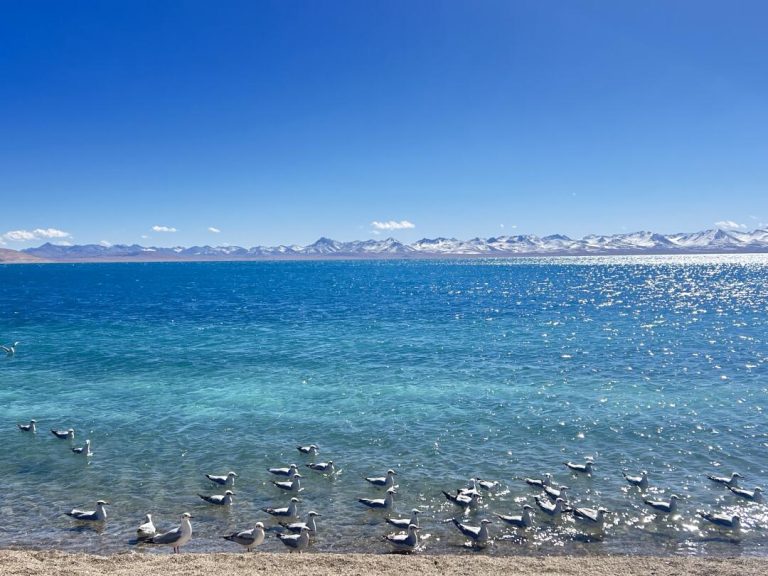
Tsering was quiet beside me, but I could sense that he, too, was in awe. He pointed to the sky, his finger tracing the outline of a constellation. “This is the Tibetan view of the stars,” he explained. “In Tibet, we see the stars as messengers from the gods, guiding us through life’s journey. This, here,” he gestured to the heavens, “is where the divine meets us.”
For a moment, I let the weight of his words sink in, and I found myself looking at the stars with new eyes. What had once been a simple night sky had become something far more profound. Each star seemed to pulse with its own life, each constellation telling a story of creation, of gods and legends, of everything and nothing at once.
The cold seemed to fade away as I sat there, transfixed by the beauty above. The wind had died down, and the lake was still once again, the surface reflecting the stars like a second sky. The moon had risen, casting its silver glow across the water, and for a brief, fleeting moment, I felt as though time itself had stopped. There was no past, no future—only the present moment, suspended in the stillness of the night.
It was then that Tsering spoke again, his voice a soft whisper. “This is the goddess’s gift to us,” he said. “The stars are her way of telling us that we are never truly alone. The night sky is a reminder that the universe is vast, but it is also a reminder that we are part of something much bigger than ourselves.”
I thought about his words long after we had retired to the warmth of our tent. As I lay there, the sound of my breath mixing with the wind outside, I couldn’t help but reflect on how, in that moment, I felt both insignificant and incredibly connected. The stars, the lake, the mountains—it was all so much larger than me, yet at the same time, I felt like I belonged to it, as if the very fabric of the universe had woven me into its tapestry.
In the days that followed, I carried the serenity of that night with me. Namtso, with its otherworldly beauty, had left a permanent mark on my soul. It wasn’t just the sight of the stars or the vastness of the lake that I would remember; it was the sense of belonging, of being part of a story far larger than my own.
And perhaps that is what Namtso truly offers those who come to its shores—a moment to pause, to reflect, and to remember that, though we may be small in the grand scheme of the universe, we are never truly alone.