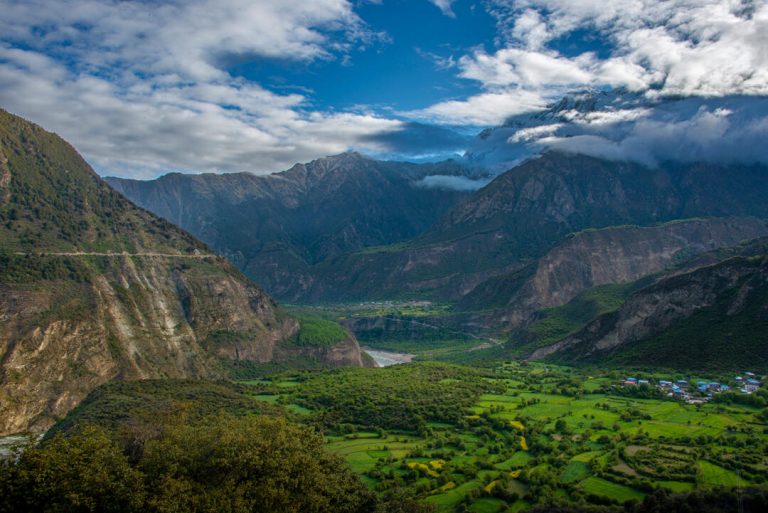
There are places on Earth that seem almost mythical—lands so remote and untamed that they feel as though they belong to another world. The Yarlung Tsangpo Grand Canyon is one of those places, a colossal chasm carved into the Tibetan Plateau by the might of the Yarlung Tsangpo River. Tsering had spoken of it often, with a glint of awe in his eyes, describing it as the deepest canyon in the world, a hidden realm where nature’s raw power is on full display.
“Many have called it the ‘Grand Canyon of the East,'” he said, his voice taking on a reverent tone, “but it is far more than that. It is the heart of the Himalayas, the cradle of Tibet’s wild spirit.”
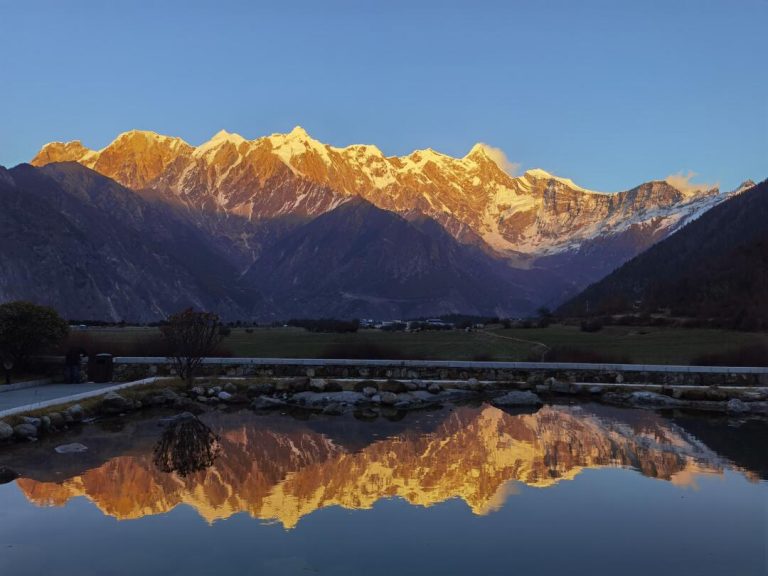
As we made our way through the narrow, winding roads leading into the heart of the canyon, the landscape around us seemed to shift with every turn. The towering peaks of the eastern Himalayas rose dramatically on either side, their snow-dusted caps jutting up against the deep blue sky. The air was crisp and cool, and with each step we took, the feeling of isolation grew stronger. It was as though we were stepping into a world untouched by time—a world where humanity had barely left a mark.
The canyon itself was a staggering sight. The river, a swift and untamed force of nature, carved its way through the gorge, cutting through sheer cliffs that rose thousands of feet on either side. The landscape was as wild as it was beautiful—an untamed labyrinth of jagged peaks, steep valleys, and dense forests. There were no roads here, no signs of civilization. Just the untamed wilderness, untouched and unyielding.
We descended further into the canyon, following a narrow footpath that wound its way through the forest. The silence was palpable—only the distant roar of the river and the occasional call of a bird broke the stillness. The deeper we went, the more isolated we felt. The towering cliffs seemed to close in around us, casting long shadows that grew longer as the sun sank lower in the sky.
Tsering, who had grown up in the region, seemed to be in his element. He moved with an easy grace, as though he had known these mountains all his life. “This canyon is not just a natural wonder,” he told me as we walked. “It is sacred to the Tibetan people. Many of the monasteries and temples around here are dedicated to protecting the spirit of the land. It is a place where the earth speaks to those who are willing to listen.”
As we ventured deeper into the canyon, the views only grew more awe-inspiring. The cliffs were painted in a spectrum of reds, oranges, and browns, their sheer faces bathed in the golden light of the afternoon sun. The river, a torrent of frothy water, snaked through the canyon floor like a great serpent, its path at times invisible, hidden behind the sharp twists and turns of the cliffs.
At one point, we came to a small clearing where we paused to rest. From here, we had a panoramic view of the canyon’s vast expanse. It was hard to fathom the scale of the place—the canyon stretched out for miles, its jagged edges disappearing into the haze of the distant mountains. The river, though far below, seemed to pulse with life, its currents rushing with a force that could sweep everything in its path.
“I often think of the river as the lifeblood of this canyon,” Tsering said, his voice soft against the backdrop of the rushing water. “It shapes everything here—the land, the people, the spirit of the place. It gives life, but it also takes it. That is the power of nature here.”
We sat in silence for a while, letting the magnitude of the place sink in. It was hard to put into words, this feeling of being so small in the face of such grandeur. The Yarlung Tsangpo Grand Canyon wasn’t just a physical place—it was a metaphor for the raw, untamed forces that shaped not only the land but also the people who lived alongside it.
As we made our way back toward the entrance, the sun dipped behind the peaks, casting a warm, golden light over the canyon walls. The river’s roar seemed to fade into the distance, and the silence of the mountains settled over us like a soft blanket. Tsering spoke once more, his words lingering in the air.
“Some say the canyon holds the secrets of the universe,” he said, his gaze fixed on the horizon. “It’s a place where time stands still, where the Earth speaks to those who are brave enough to listen.”
As we left the canyon behind, I couldn’t help but reflect on Tsering’s words. It was as though we had glimpsed something deeper, something ancient that lay at the heart of the world. The Yarlung Tsangpo Grand Canyon had revealed to me the sheer power of nature, the quiet hum of the earth that continues to pulse beneath the surface. In that silence, in that wildness, I felt something stir within me—a connection to the land that was as old as the mountains themselves.
Leaving the canyon felt like leaving a part of myself behind, a part of something that was bigger than I could ever understand. Yet, I knew that the canyon would remain with me long after I left—its spirit, its power, and its beauty forever etched into my memory.