
The moment we arrived in Linzhi, it felt as though we had stepped into a different world—a place where time itself seemed to slow down and nature unfolded in the most delicate and breathtaking ways. Known as the “Little Tibet” of the east, Linzhi is a land of enchantment, nestled between the great Himalayas and the dense forests of the southeastern Tibetan plateau. Here, the air is softer, the temperature milder, and the landscape, a painter’s dream: rolling valleys filled with trees, rivers, and meadows, all bathed in the gentle glow of spring.
Tsering had been speaking with great excitement during the drive, his words weaving the history and beauty of the region together. “Linzhi,” he said, “is often called the ‘Shangri-La’ of Tibet, because of its lush beauty. It’s a place of rebirth in spring—when the peach trees blossom, it feels like the land is waking up from a long, dreamless sleep.”
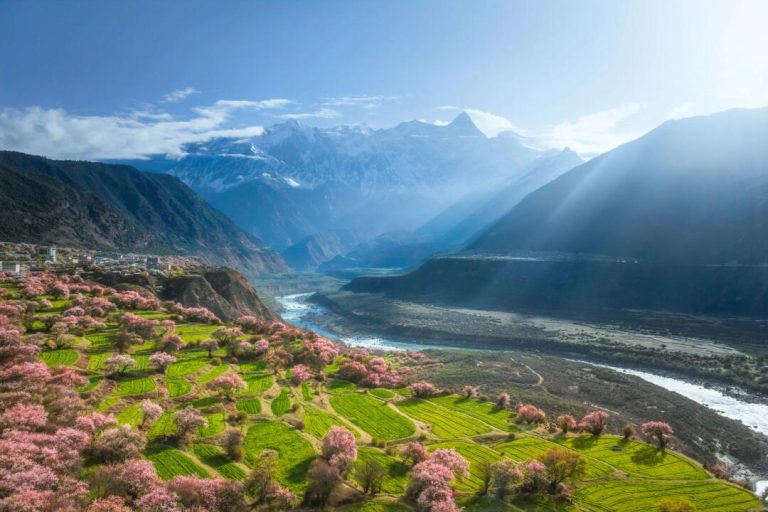
As we ventured deeper into the valley, we saw it—fields of pale pink and white, stretching as far as the eye could see. The peach blossoms were in full bloom, their soft petals gently falling like confetti, blanketing the ground in a carpet of delicate color. It was as though we had entered the heart of a dream, where every corner seemed to whisper of peace, of hope, and of renewal.
I couldn’t help but feel a sense of awe. The beauty of the landscape was almost surreal, as if it had been sculpted by some divine hand. The peaks of the Himalayas stood like silent sentinels in the distance, their snow-capped heads shrouded in a mist that lent them an ethereal quality. Beneath them, the peach orchards sprawled out in their delicate splendor, their flowers shimmering in the sun’s soft light. Tsering guided us through the fields, sharing stories of local life and traditions.
“This valley is known for its agriculture, especially peaches,” he explained. “The fruit here is sweet, but more than that, it is said to be a symbol of prosperity and good fortune. The peach blossoms, which only bloom for a short while, remind us of the fleeting nature of life and the beauty that exists in impermanence.”
As we wandered through the orchards, I marveled at the delicate fragrance that filled the air. The scent of the blossoms was subtle but intoxicating, a blend of sweetness and earthiness that seemed to cleanse the mind and soothe the soul. I watched as local villagers, their faces weathered by years of labor but radiant with smiles, moved between the trees, picking blossoms and preparing them for sale at the local markets. It was a simple life, but one that seemed to flow in perfect harmony with the rhythm of the land.
We continued to explore, making our way to a small temple nestled on a hill that overlooked the valley. Tsering explained that the temple had been a pilgrimage site for centuries, revered by both Buddhists and local people alike. It was a place where the energy of the earth seemed to converge, where one could feel the sacredness of the land beneath their feet.

The temple was quiet, save for the soft murmur of prayers drifting from the prayer flags fluttering in the breeze. Inside, a small statue of Tara, the goddess of compassion, sat in peaceful repose. I took a moment to sit before the statue, allowing the serenity of the place to wash over me. It was hard to describe, but in that moment, I felt a profound connection to the land, to the history of the place, and to the simple beauty that surrounded us. Linzhi wasn’t just a place—it was a feeling, a sensation that permeated everything.
The afternoon passed in a haze of quiet reflection and exploration. We walked through narrow paths lined with old, moss-covered stones and beside streams that cut through the valley, their waters clear and cool. Everywhere, the peach blossoms continued to unfold, their petals floating on the breeze, each one a reminder of the fleeting nature of time, of life’s ephemerality. And yet, in their short-lived beauty, there was a message: that beauty, even in its transience, is worth cherishing.
As the sun began to dip behind the mountains, casting long shadows across the valley, we found a quiet spot by a river to sit and reflect. Tsering spoke again, his voice soft as the evening light. “The peach trees bloom for only a short time, but their beauty is eternal in our hearts. Life, too, is like that—fragile and fleeting, but filled with moments that, once experienced, live on in our memories forever.”
I thought about his words as the sky turned from soft pink to deep purple, and the stars began to emerge, one by one, in the clear Tibetan sky. Here, in this peaceful corner of Tibet, surrounded by nature’s splendor, I felt a deep sense of peace. The world felt distant, its noise and chaos a far-off echo, drowned out by the silence of the valley and the rhythmic sound of the river’s flow.
Linzhi had become more than just a destination—it had become a part of me. The memory of the peach blossoms, the scent of the flowers, and the serenity of the valley would stay with me long after I left. It was a place where time slowed down, where nature revealed its secrets, and where the heart could find peace in the simplest of moments.
As we drove away the next morning, I looked back at the valley one last time, the peach blossoms already beginning to fall from the trees. But even as they fluttered to the ground, they seemed to leave behind a promise—that, no matter how fleeting the moment, its beauty would endure, carried forever in the heart.